

Countertop compost storage only works well when the bin matches the pace of the kitchen. Capacity, lid design, liner setup, and clean-out ease all matter once food scraps start piling up after dinner prep.
The six compost pails below cover small apartments, busy family kitchens, and style-led counters. Some lean toward practical capacity, others toward cleaner lines or easier washing, so the right choice depends on how much waste builds up between trips outside.
The Shortlist At A Glance

Perfnique 1.3 Gal Kitchen Compost Bin

EKO Kitchen Compost Bin 7L / 1.85 Gal

KIBAGA Beautiful Kitchen Compost Bin 1.1 Gallon

KAZAI. Elin Compost Bin 1.2 GAL / 4.5L

KAZAI. Elin Compost Bin 1.2 GAL / 4.5L
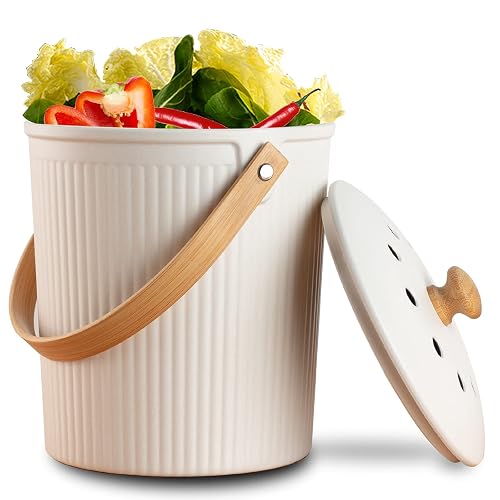
LALASTAR Countertop Compost Bin 1 Gallon
More Details On Our Top Picks
Perfnique keeps the format straightforward, with a 1.3-gallon body that sits comfortably on a counter without feeling tiny. The inner bucket liner adds a practical layer for emptying and cleanup, while the carbon filter points to a more controlled lid setup for daily scraps.
That balance suits households that generate steady peelings, coffee grounds, and plate scrapings during the week. Compared with the sleeker KIBAGA bin, this one feels more utility-first, which is useful in a busy kitchen where function tends to matter more than a decorative finish.
Strong Points
- 1.3-gallon size offers more breathing room than the smaller 1.1-gallon KIBAGA bin.
- Inner bucket liner should make daily emptying less messy.
- Carbon filter setup helps the lid work harder against lingering food smells.
- Compact enough for countertop use without taking over prep space.
Things To Consider
- Farmhouse styling is present, but the look leans practical rather than decorative.
- Carbon filters usually add a small maintenance routine over time.
- The listing gives no material detail, so finish and durability cues are limited.
Feature Snapshot
Who It Suits Best
Households that want a mid-size countertop compost bin with a practical insert will find the layout easy to live with.
Where A Sibling Pick Shines
Perfnique gives way to the KIBAGA Beautiful Kitchen Compost Bin for shoppers who care more about a cleaner display piece than extra capacity.
The EKO model moves up in size and material quality, with stainless steel giving the bin a more finished countertop presence than the first pick. Its 7-liter capacity, roughly 1.85 gallons, also buys more time between trips to the outdoor pile or main compost system.
The removable inner bucket simplifies handling, and the deodorizer compartment adds a second line of defense for odor control. In a kitchen that sees daily cooking, that extra structure can feel like a sensible upgrade, though the metal shell will also show fingerprints more readily than softer finishes.
Highlights
- Stainless steel exterior brings a cleaner, more durable feel to the counter.
- 7-liter capacity suits households that build up scraps quickly.
- Removable inner bucket makes emptying and rinsing more manageable.
- Deodorizer compartment adds a useful layer for odor-sensitive kitchens.
- Black finish keeps the profile restrained beside modern appliances.
Points To Note
- Stainless steel tends to show smudges more than matte plastics or coated fiber.
- Higher capacity also means more room occupied on the countertop.
- The extra deodorizer feature adds another part to maintain over time.
Core Details
Who Will Love This
Busy kitchens and style-conscious homes that want more capacity without moving to a bulky floor bin will get the most from this EKO design.
Another Choice May Suit
Perfnique 1.3 Gal Kitchen Compost Bin makes more sense for smaller counters where a lighter, less metal-heavy profile feels easier to live with.
KIBAGA leans hard into a clean countertop presence, and the 1.1-gallon size keeps it from feeling oversized in compact kitchens. The smell-proof lid and rust-proof body speak to low-fuss daily use, especially in spaces where the bin lives in sight rather than hidden under the sink.
Compared with the more utilitarian Perfnique, this one feels closer to decor that happens to be useful. The trade-off is capacity, since smaller households may appreciate the slimmer footprint while larger cooking routines could fill it quickly.
Upsides
- Neat, minimal profile suits counters that already carry a lot of visual clutter.
- Smell-proof lid is a strong fit for indoor use between emptying cycles.
- Rust-proof construction should suit kitchens with regular wipe-down cleaning.
- 1.1-gallon size works well in apartments and smaller households.
Minor Gripes
- Smaller capacity means more frequent emptying in busy cooking weeks.
- No filter system is called out in the source details.
- The decor-first styling may matter less to shoppers focused only on utility.
Quick Facts
Right Fit For
Apartment kitchens, compact counters, and homes that want the compost bin to blend into the room rather than stand out.
A Better Fit Elsewhere
EKO Kitchen Compost Bin 7L / 1.85 Gal suits larger households that want more capacity and a sturdier metal build.
KAZAI’s Elin keeps things compact but not cramped, with a 1.2-gallon size and an inner bucket that should make handling scraps less awkward. The carbon filter and dishwasher-safe note point to a bin built for more regular, low-friction upkeep in a small kitchen.
That combination puts it in a useful middle ground between the practical Perfnique and the more decorative KIBAGA. The sage-green finish also brings a softer tone to the counter, which suits kitchens that want a little color without moving into loud territory.
Reasons To Buy
- 1.2-gallon size keeps the bin manageable on tight countertops.
- Carbon filter adds a familiar odor-control layer for indoor use.
- Inner bucket helps with quick lift-out and cleaning.
- Dishwasher-safe construction can simplify routine upkeep.
Softer Spots
- Slightly smaller than the Perfnique bin, so capacity stays modest.
- Sage-green styling may not match every kitchen finish.
- Filter-based odor control still asks for periodic attention.
Details At A Glance
Built With In Mind
Small kitchens and apartment setups that want a compact, easy-care compost pail with a softer visual profile.
Swap It Out When
Perfnique 1.3 Gal Kitchen Compost Bin suits households that want a touch more capacity while keeping the same kind of everyday countertop role.
This version of the Elin keeps the same 1.2-gallon footprint but swaps in a wooden lid, which shifts the look toward warmer, more furniture-like kitchen styling. The inner bucket and dishwasher-safe note still point to easy daily handling, so the aesthetic change does not seem to come at the expense of basic usability.
Against the sage-green Elin, this one feels better suited to off-white, oak, or bamboo-heavy kitchens. The honest read is that the wooden lid matters most to anyone who wants the compost pail to sit out in plain sight and still look considered.
Plus Points
- Wooden lid gives the bin a warmer, more finished appearance.
- Same 1.2-gallon capacity stays practical for daily countertop use.
- Inner bucket supports easier emptying and cleaning.
- Dishwasher-safe care keeps maintenance straightforward.
Room For Improvement
- Style-forward lid may matter less in utility-first kitchens.
- The capacity remains modest for larger cooking households.
- Wood surfaces often need a little more care than plain synthetic lids.
Feature Rundown
Whose Shelf It Belongs On
Warm-toned kitchens and design-led spaces that want compost storage to blend into the room rather than look purely utilitarian.
Look Elsewhere When
KIBAGA Beautiful Kitchen Compost Bin fits better for shoppers who want a cleaner-looking lid profile and a slightly different visual tone.
LALASTAR keeps the formula simple, using bamboo fiber to give the pail a lighter, more natural feel than the stainless steel EKO or the wood-lid Kazai version. The 1-gallon capacity suits smaller kitchens, especially where the bin is expected to sit near a prep zone without drawing much attention.
For light daily scraps, that can be enough, and the odorless positioning suggests a straightforward indoor role. The trade-off is capacity, so heavier cooking routines may call for more frequent emptying than the 1.3-gallon Perfnique or the 1.85-gallon EKO.
Best Bits
- Bamboo fiber construction gives the bin a natural, restrained look.
- 1-gallon size fits compact kitchens with limited counter space.
- Simple lid design keeps the bin easy to place and use day to day.
- Low-profile styling works well in rooms with softer finishes.
Areas To Watch
- Smaller capacity means more frequent emptying in active kitchens.
- The minimalist design offers less built-in feature layering than EKO or KAZAI.
- Light-colored finishes can show use sooner than darker shells.
Key Specs
Who Should Grab It
Smaller households and design-conscious kitchens that want a simple, natural-looking compost pail with a compact footprint.
Reach For A Different Pick When
EKO Kitchen Compost Bin 7L / 1.85 Gal suits larger scrap volumes and households that want more capacity before emptying.
How To Choose The Right compost pails for kitchen
Capacity, Counter Space, And Emptying Rhythm
Capacity is the first practical filter. A 1-gallon bin like LALASTAR fits lighter scrap loads and compact counters, while the 1.85-gallon EKO suits kitchens that fill up faster. The middle sizes from Perfnique and both KAZAI Elin versions work well for most everyday cooking routines.
Emptying rhythm matters just as much as raw size. A smaller pail can be easier to place beside a cutting board, but it may need more trips to the main compost area. Larger bins buy convenience, then ask for more counter space in return.
Material, Cleanup, And Day-To-Day Care
Stainless steel, bamboo fiber, and mixed-material builds each bring a different feel. Steel tends to look sharper and handle heavy use well, while bamboo fiber softens the visual footprint in a kitchen with natural finishes. Decorative lids, like the wooden KAZAI version, often matter most in rooms where the bin stays visible.
Cleanup should stay simple enough to repeat often. Removable inner buckets help with rinsing and emptying, and dishwasher-safe construction can trim the friction that causes small kitchen tools to sit dirty for too long. Carbon filters or deodorizer compartments add another layer, though they also add another part to maintain.
Lid Design And Odor Control
Lid design does more than close the bin. A smell-proof or carbon-filtered lid helps keep the countertop more comfortable between emptying cycles, especially in warm weather or after cooking onions, fish, or coffee-heavy breakfasts. The trade-off is ongoing upkeep, since filters and odor-control parts are not set-and-forget pieces.
Plain lids still work well in smaller households that empty the pail often. In busier homes, the more layered lid systems on EKO and Perfnique make the most sense because they extend usable time between resets.
Style Fit And Placement
The bin lives in view, so appearance matters more here than in many kitchen tools. KIBAGA suits a clean, decorative counter, KAZAI’s two Elin versions fit softer or more modern palettes, and LALASTAR lands in a natural, minimal lane. That visual fit can decide whether the pail feels like part of the room or something that needs to be hidden.
Placement also affects comfort. A bin beside the sink or prep board works well for most kitchens, but a bulkier body can crowd narrow galley layouts. Compact models solve that issue, though they trade away some capacity.
Things Worth Knowing First
Mistakes Worth Dodging
Capacity gets overestimated often. A small bin sounds neat on paper, then fills fast during a weekend of chopping, baking, or meal prep. Matching the size to the cooking rhythm is more useful than chasing the largest number on the page.
Odor control also deserves a sober look. A filter or deodorizer helps, but it does not remove the need for regular emptying. Relying on a lid alone can leave a kitchen feeling stale by the end of the day.
The Case For Spending Up
Higher-tier models usually charge more for materials, finish quality, and extra parts. Stainless steel, removable inner buckets, and deodorizer compartments all add cost because they improve handling, cleaning, and appearance. That matters most in kitchens where the bin sits in open view and gets used constantly.
The upgrade makes sense for heavy cooks and style-led homes. Simpler bins still cover light use well, but a more refined model can feel easier to live with over the long haul.
Wrap Up
The best compost pail for a kitchen is the one that fits the pace of the room, not just the scraps on a shopping list. Perfnique and EKO handle busier routines well, KIBAGA brings the strongest decor angle, and the two KAZAI Elin versions make sense for compact, style-conscious spaces. LALASTAR stays appealing for smaller kitchens that want a simpler profile. A good match turns daily food waste into one less thing to think about.
